

South Africa’s battle against inflation appeared to be moving in a more stable direction only a few months ago. Food prices were easing across key categories and consumer price growth remained broadly contained. For a sustained period, inflation stayed within the South African Reserve Bank’s target range, which helped reduce pressure on households and businesses.
That sense of stability is now beginning to weaken as new data points to a renewed rise in price pressures. The shift is not dramatic in scale, but it is significant enough to warrant closer attention from policymakers and markets.
South Africa’s annual consumer inflation rate rose to 4.5% in May 2026, up from 4.0% in April, according to Statistics South Africa. This marks the highest reading since July 2024 and signals a clear break from the recent cooling trend. On the surface, it suggests that cost pressures are building again across the economy. However, the underlying drivers tell a more specific story. The increase is not being driven by a broad-based rise in prices but by a concentrated surge in fuel costs.
A closer reading of the data shows that fuel inflation is doing most of the work behind the headline figure. This separates the current movement from a broad inflation surge. Instead, the evidence points more clearly to a sector-specific shock. While the headline rate has moved higher, many core price categories remain relatively stable. Inflation pressure is therefore uneven rather than widespread. The rise is real, but it is narrow in its source.
Even so, higher fuel costs are beginning to place renewed pressure on consumers and businesses. If sustained, these costs will filter through transport, logistics and production channels. That transmission is how isolated price shocks often evolve into broader inflation trends. For now, the pressure remains contained, but the direction of travel will be closely watched in the months ahead.
Fuel prices are driving the inflation story
The most striking feature of the inflation data was the sharp rise in fuel costs. According to Patrick Kelly, chief director for price statistics at StatsSA, fuel index recorded its second consecutive large increase, leaping by 14.3% in May alone, reflecting a steep monthly acceleration in energy prices. On an annual basis, fuel inflation rose to 28.7%, highlighting how strongly transport-related costs are shaping the current inflation reading.
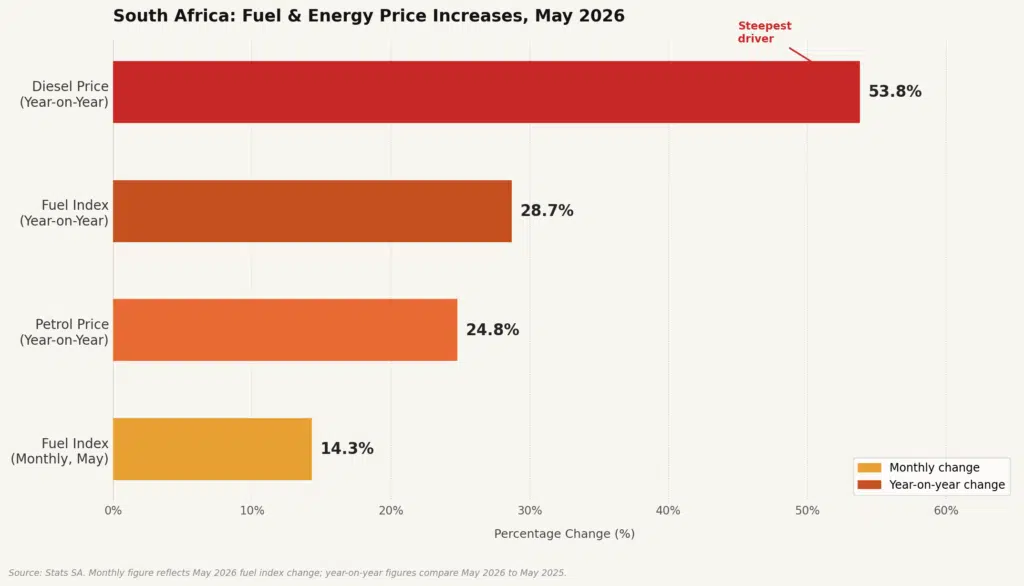
Petrol prices were 24.8% higher than a year earlier, while diesel prices climbed even more sharply by 53.8%. These increases were a central driver of the rise in headline inflation over the period under review.
A clearer picture emerges once fuel is removed from the inflation basket. Inflation excluding fuel remained unchanged at 3.7% in May, the same level recorded in April. This measure has stayed broadly stable over the past year, suggesting that underlying price pressures in the wider economy have not materially shifted.
Outside energy, most consumer price movements remain contained and relatively steady. This reinforces the view that the latest inflation increase is being driven by a narrow but powerful cost shock rather than a generalised rise in prices.
For policymakers, this creates a more complex challenge than a typical inflation cycle. Fuel price increases feed quickly into transport costs, logistics pricing and broader business operating expenses. However, these pressures are largely shaped by global oil markets and exchange rate movements, both of which lie outside direct domestic policy control. This limits how effectively traditional monetary tools can respond to the current inflation impulse.
According to Ayodeji Olatunji, an energy and macroeconomic analyst, this is what makes the current episode structurally different from demand-driven inflation.
“What we are seeing is not demand-driven inflation but imported cost pressure through fuel,” he told Businessfront. “Interest rates can influence domestic demand, but they cannot offset global oil pricing or currency pressure. That is why fuel-driven inflation tends to be more persistent in its impact, even when it is not broad-based.”
This dynamic underscores a broader risk for the inflation outlook. Even when fuel-driven inflation remains narrow at first, it can still influence pricing behaviour across transport, goods and services if it persists. The concern for policymakers is therefore not only the initial shock, but whether it begins to shape expectations and cost structures more widely across the economy.
Why higher fuel costs matter to every South African
For households, rising fuel prices are first felt at the pump. The immediate impact is visible in daily transport costs, especially for commuters and small businesses that rely on mobility. But fuel’s role in the economy goes far beyond direct consumption. It sits at the centre of how goods, services and people move across the country, making it one of the most influential cost drivers in the system.
When fuel costs rise, the impact is transmitted in stages through the economy. Transport operators adjust prices. Logistics firms revise delivery charges. Businesses then absorb or pass on these costs depending on market conditions. Over time, these adjustments feed into the prices consumers eventually pay. This is why fuel inflation is closely monitored even when headline inflation appears stable. It carries the potential to reshape pricing dynamics across multiple sectors.
For businesses operating in a weak growth environment, higher transport and logistics costs add further strain. Many firms have limited room to absorb additional expenses, particularly in competitive sectors with weak pricing power. Smaller businesses are especially exposed due to thinner margins and limited access to cost hedging tools. In such cases, rising fuel costs can force difficult decisions around pricing, staffing or operations.
Consumers also feel the effects in indirect but important ways. Higher transport costs can gradually influence the price of food, household goods and essential services. This can occur even when agricultural output remains stable and supply conditions are favourable. Over time, fuel-driven inflation can therefore reshape household budgets well beyond mobility spending.
Food prices offer consumers some relief
One reason inflation has not risen more sharply is the continued moderation in food prices. While fuel costs have pushed headline inflation higher, food inflation has moved in the opposite direction. Food and non-alcoholic beverage inflation fell to 1.9% in May from 2.9% in April. This is also well below the 5.7% peak recorded in July 2025, indicating sustained easing in food price pressures.
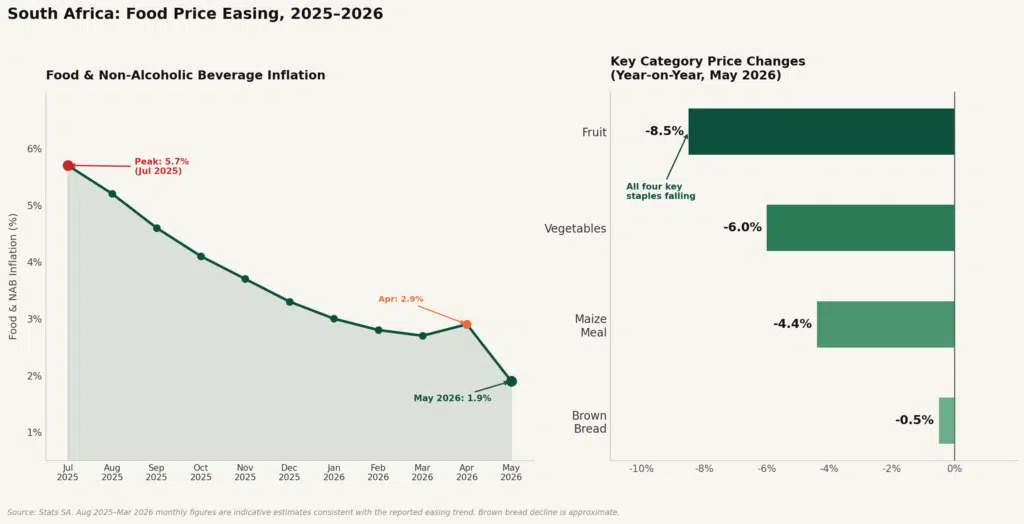
Several key categories recorded outright declines. Maize meal prices were 4.4% lower than a year earlier, while brown bread also saw a slight annual decline. Fruit prices fell by 8.5% and vegetable prices declined by 6.0%. These movements reflect broad-based easing across key household staples, particularly in fresh produce markets.
Meat prices remain higher year-on-year but are also cooling. Annual meat inflation slowed to 7.3% in May from 9.4% in April. Within the category, items such as stewing beef and beef mince recorded monthly declines. This suggests that earlier cost pressures in protein markets are beginning to stabilise.
For households, this moderation provides important relief at a time when wage growth remains weak and living costs are still elevated. Lower food inflation helps protect disposable income, particularly for lower and middle-income households that spend a larger share on essentials. It also reduces the risk of a sharper squeeze on consumption despite rising fuel costs.
The contrast between food and fuel inflation highlights the unusual structure of the current inflation environment. In previous cycles, food and energy prices often rose together, reinforcing inflationary pressure. In this cycle, food inflation is easing while fuel inflation is accelerating. This divergence has helped contain headline inflation and prevented a sharper rise in overall price levels.
Global factors are playing a role
South Africa’s fuel prices are heavily shaped by external conditions. International oil markets remain sensitive to geopolitical tensions, supply disruptions and shifts in global demand. Movements in crude oil prices are quickly reflected in imported fuel costs, making domestic inflation highly exposed to global cycles.
Exchange rate movements add another layer of pressure. Because oil is priced in US dollars, any weakening of the rand immediately raises the local cost of fuel imports. This means fuel inflation can be driven by either global oil price increases, currency depreciation, or both. In effect, South Africa imports a significant portion of its fuel inflation risk.
These dynamics make fuel inflation difficult to manage through domestic policy tools. Unlike demand-driven inflation, imported energy shocks are not generated by domestic consumption. They are transmitted through global markets and exchange rate channels.
Sarah Mokoena, an energy economist, said this limits the effectiveness of conventional policy responses. She noted that South Africa has little control over the forces driving fuel prices.
“South Africa is largely a price taker when it comes to fuel,” she told Businessfront. “The central bank can manage demand conditions, but it cannot insulate consumers from global oil cycles or currency pressure. That is why fuel-driven inflation tends to be more volatile and harder to reverse quickly.”
Her point highlights a structural constraint in how inflation is managed in an open economy like South Africa. According to her, monetary policy can influence domestic demand and anchor expectations, but it cannot offset shocks that originate in global energy markets or foreign exchange movements.
A fresh challenge for the South African Reserve Bank
The latest inflation figures arrive at a sensitive moment for monetary policy. South Africa’s inflation target range remains between 3% and 6%, with policymakers generally preferring inflation to remain close to the midpoint. At 4.5%, inflation is still within target. However, the upward trend will attract attention from policymakers assessing future interest-rate decisions.
The key concern for the Reserve Bank is whether fuel-driven inflation remains contained or begins spreading into broader price behaviour. If transport and input costs continue rising and businesses pass them on, inflation could become more persistent. In that case, policymakers may lean towards a more cautious interest rate stance.
Higher rates would not directly reduce fuel prices, but they could limit second-round effects by containing demand and anchoring expectations. However, this approach also carries risks for growth in a low-demand environment. If fuel prices stabilise and food inflation remains subdued, inflation could ease again without further policy tightening.
The next few months will therefore be critical and closely watched, not only for inflation outcomes but also for evidence of whether fuel-related pressures are spilling into other parts of the consumer basket. For now, the situation remains finely balanced, with both risks and relief factors still in play.
Should businesses and households worry?
South Africa’s latest inflation data underscores the country’s continued exposure to external energy shocks. At the same time, broader economic conditions remain fragile, with the labour market showing renewed weakness.
Recently, South Africa reported a further deterioration in employment conditions, with the official unemployment rate rising to 32.7% in the first quarter of 2026, up from 31.4% in the fourth quarter of 2025. This combination of rising prices and weakening job conditions adds a more difficult layer to the cost-of-living environment.
While food prices have provided some cushioning, fuel remains a dominant driver of inflation dynamics. Changes in petrol and diesel prices quickly influence transport, production and retail activity across the economy. This makes fuel not just a household expense issue, but a system-wide cost factor that shapes pricing decisions across multiple sectors.
The current data does not yet point to a broad-based inflation resurgence. Inflation excluding fuel remains stable, suggesting that many parts of the economy are still relatively contained. However, fuel shocks rarely remain isolated if they persist over extended periods or if they begin to influence pricing behaviour across transport and supply chains.
For households, the immediate pressure is higher transport and energy costs at a time when unemployment is also rising, which further constrains disposable income. For businesses, it translates into rising operating expenses and tighter margins, especially in sectors with limited pricing power. For policymakers, it creates a dual challenge of monitoring inflation risks while also accounting for weakening labour market conditions.
South Africa’s inflation problem has not structurally returned. But the sharp rise in fuel prices has disrupted the recent period of stability and reintroduced uncertainty into the outlook. The key test now is whether this remains a contained energy shock or evolves into a broader inflation cycle. In the meantime, the overlap between rising fuel costs and rising unemployment highlights a more complex economic strain than inflation data alone suggests.