

When Nigeria rewrote its tax laws last June, the government made a clear choice. Rather than squeeze households and small businesses harder, it shifted more of the burden onto larger companies.
Under the Nigeria Tax Act 2025, firms with annual turnover of ₦100 million or less and fixed assets below ₦250 million are exempt from major corporate taxes effective January 1, 2026. These include the standard 30% company income tax (CIT), a 4% Development Levy and Capital Gains Tax.
By quadrupling the revenue threshold from ₦25 million, policymakers opted to rely on big businesses to lift revenue.
So far, the CIT wager has yet to pay off.
New data from the National Bureau of Statistics (NBS), Nigeria’s data agency, shows that company income tax collections fell by 31% year on year to ₦1.37 trillion in the first quarter of 2026, Receipts were also down 8.8% from the previous quarter. The decline, driven largely by weaker foreign collections, marks one the earliest tests of the country’s most ambitious tax overhauls in decades.
A narrow pool of contributors
A closer look at the Q1 data reveals that the drop in corporate tax collections was broad-based. Both domestic and foreign firms paid less tax than a year earlier, suggesting that the decline was not simply the result of the new exemptions for smaller businesses.
The sharpest drop came from non-resident companies, whose payments fell 38% year-on-year to ₦828.8 billion from ₦1.34 trillion in Q1 2025. Resident company income tax receipts, meanwhile, dropped at a slower pace, falling 16% to ₦538.9 billion.
Beneath the headline figures lies an old problem. Nigeria still relies on a narrow pool of taxpayers.
Finance, mining and manufacturing accounted for almost 60% of company tax receipts during the quarter. The financial-services industry remained the largest contributor and the only major sector to record growth. Tax payments rose to ₦133.2 billion from ₦117 billion a year earlier, helped by strong banking profits and fresh capital injections following the recapitalisation exercise
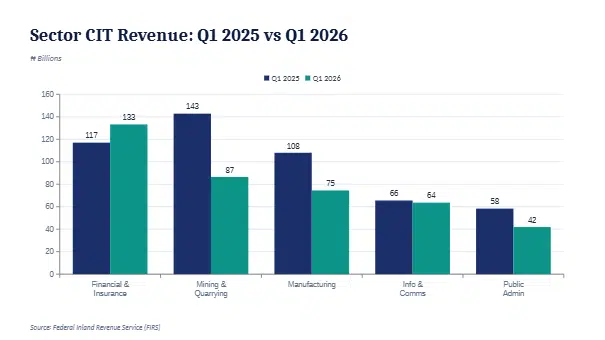
Elsewhere, the picture was less encouraging. Collections from mining and quarrying fell to ₦86.5 billion from ₦142.8 billion, reflecting the continued gap between Nigeria’s resource potential and actual production.
Manufacturing receipts dropped to ₦74.5 billion from ₦108 billion, while information and communication services contributed ₦63.6 billion, slightly below the previous year’s level despite robust output growth. Payments received from public administration and defence, historically a major contributor to the local CIT pool, also declined sharply.
At the other end of the spectrum, large parts of the economy barely register in the corporate tax net. Activities of households as employers accounted for just 0.01% of collections, while water supply, waste management and extra-territorial organisations together contributed less than 1%.
That concentration carries risks for the country’s fiscal stability. A tax system that relies heavily on banks, oil-linked activities and a handful of large corporations is inherently vulnerable to swings in profitability, commodity prices and economic cycles. The latest figures suggest that broadening the tax base may prove just as important as raising the tax burden on those already paying.
Big companies record bumper earnings
The fall in CIT collections becomes even more striking when you look at the Q1 earnings of Nigeria’s biggest firms.
Financial statements filed on the Nigerian Exchange shows that at least eight companies generated more than $500 million in revenue during the period. Several crossed the trillion-naira mark for the first time.
Telecommunications giant MTN Nigeria topped the list with ₦1.49 trillion in revenue, making it the only company to surpass the $1 billion mark. Access Holdings followed with ₦1.37 trillion. Dangote Cement and Seplat Energy reported ₦1.19 trillion and ₦1.16 trillion respectively.
Ecobank Transnational Incorporated, Zenith Bank, First HoldCo and United Bank for Africa also featured among the biggest earners, underlining the growing heft of finance in corporate Nigeria.
The rise in turnover translated into stronger profitability.
Combined net earnings among the companies reviewed climbed from ₦1.35 trillion in the first quarter of 2025 to ₦1.86 trillion a year later, an increase of nearly 40%. In dollar terms, the picture was even brighter. Using an exchange rate of roughly ₦1,560/$1 for Q1 2025 and ₦1,386/$1 at the end Q1 2026, those figures rose by 55% from about $865 million to $1.34 billion.
Broader business activity also indicated resilience. S&P Global’s Purchasing Managers’ Index (PMI), a closely watched gauge of Nigeria’s private-sector health, remained in expansionary territory for most of the quarter.
The readings signaled improving business conditions, despite higher fuel costs and renewed inflationary pressures from geopolitical tensions.
Taken together, the figures point to a corporate sector that has largely adapted to Nigeria’s difficult operating environment. Revenues are rising, profits are growing and business activity is expanding. Against that backdrop, the decline in CIT receipts becomes harder to ignore.
More than one tax
The mixed results raises an obvious question: are Nigeria’s tax reforms already falling short?
Tax experts say it is too soon to tell. The new laws only came into force this year and a single quarter may not provide a reliable guide.
“Remember, most companies close their books in December and file returns in the second quarter, so the first-quarter figures may not yet capture the effects of the new laws,” Dejo Adeyemi, a partner at Andersen in Nigeria, told BusinessFront.
Adeyemi also cited the latest jump in value-added tax as evidence that early revenue trends can be misleading. Despite wider exemptions for essential goods and a higher registration threshold for smaller businesses, VAT climbed 17.6% year-on-year to N2.4 trillion, defying expectations.
Analysts further caution against treating CIT as a measure of the entire corporate tax system. Businesses are subject to a range of other levies, including the development levy, capital gains tax and sector-specific taxes. For example, the petroleum profits tax carries a headline rate of 60% for upstream oil and gas companies.
They argue that strong collections from those sources could offset weaker company income tax receipts.
The reforms themselves go beyond adjusting tax rates. By streamlining tax administration, introducing incentives and tightening enforcement, the government aims to improve compliance and plug existing revenue leakages. Officials say these changes are already yielding desired outcomes.
According to the Nigerian Revenue Service, tax revenue rose to ₦15.8 trillion in the first five months of 2026, up from ₦10.6 trillion a year earlier and above target. Oil tax revenue climbed more than 20% to ₦3.96 trillion, while non-oil collections increased 12.3% to ₦8.2 trillion, reflecting increased compliance across key sectors.
The question now is whether CIT will eventually catch up with the broader revenue trends.