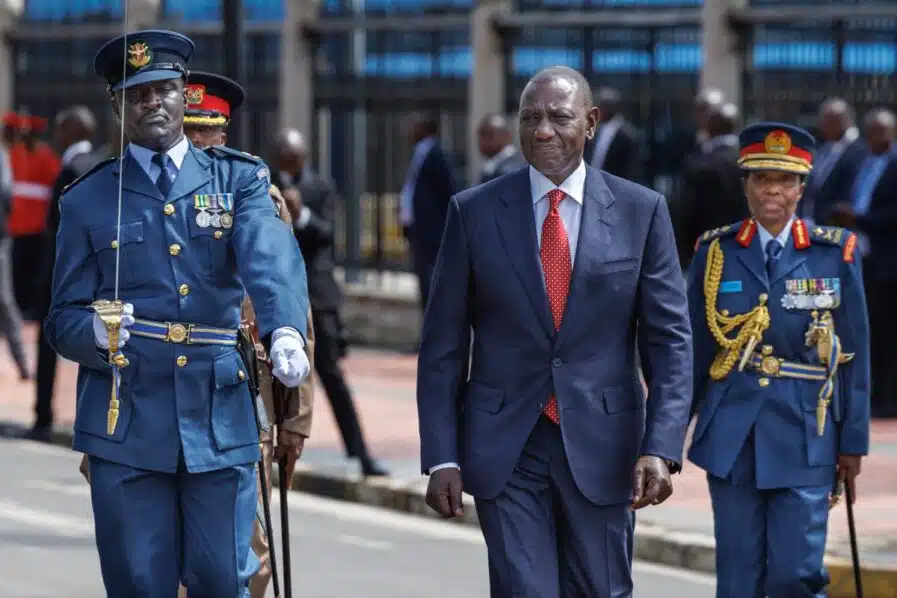


WILLIAM RUTO does not lack the flare for the theatric. Standing before residents of Kajiado county last week, the Kenya’s president announced that Tata Chemicals, an Indian firm that has mined soda ash from Lake Magadi for more than a century, would be made to “pack and leave.” A new tender would be opened, he said, to companies willing to build glass and chemical factories on Kenyan soil rather than ship raw minerals abroad.
Days later he turned to a humbler and more vulnerable target. Foreign hawkers selling duvets and cheap merchandise on Nairobi’s pavements would also have to close shop, he announced, with enforcement beginning the following week. Investors are welcome in Kenya; peddlers are not — the 59-year-old democratic leader of the East African nation says.
The two announcements, arriving within days of each other, are not isolated bursts of an overly enthusiastic politician. They form the opening moves of a campaign built around economic populism and protectionism, one that Mr Ruto hopes will carry him into a second term when Kenyans vote in August 2027. His government insists the measures are about fairness and value addition. His critics see a president reaching for scapegoats as his popularity sags and the economy refuses to cooperate.
Making a scapegoat of foreign businesses
Mr Ruto’s language on Tata Chemicals was poignant. The company, he said, had been “taking our resources to India” for a hundred years without building so much as a factory in Kajiado. His new terms for whoever replaces Tata are local processing, local jobs, and a cap on how much land any single investor may hold.
Officials frame this as a progressive industrial policy, an effort to keep value inside Kenya rather than export it raw.
“Value addition is going to be done here in Kenya,” Mr Ruto told residents, promising that raw minerals would no longer leave the country for processing elsewhere.
There is a case to be made for that argument, and soda ash is no trivial export for Kenya. The country shipped around 255,000 tonnes of the mineral abroad last year, worth roughly Sh7.4 billion, or about $57 millon, making it one of Kenya’s more reliable earners even as its per-tonne value has slipped in recent years.
Opposition figures however, including allies of the former deputy president, Rigathi Gachagua, have gone further, accusing Mr Ruto of engineering Tata’s exit to clear the way for businessmen closer to him, a claim the government denies.
Yet the same week brought a directive against people with far less capital than a multinational chemicals firm. Foreign nationals hawking goods on the street, mostly small traders from elsewhere on the continent and beyond, were told to cease operating or face closure. A bill before parliament, the Local Content Bill, would go further still, requiring foreign firms to fill most senior roles with Kenyan citizens and source the bulk of their goods locally.
Mr Ruto insisted the country had not built investor confidence “so that hawkers could come.” The distinction between a mining conglomerate and a street vendor selling duvets is considerable, but both now sit under the same nationalist banner, and both offer a simpler explanation than the one Kenyans actually face at the till.
Foreign businesses make a convenient villain because they cannot vote. Blaming outsiders for scarce jobs is far less costly than confronting the domestic causes of Kenya’s strain, from a heavy tax burden to a labour market that has not kept pace with a young population.
A failed tax bill that result in bloodshed
Mr Ruto’s populism turn cannot be understood apart from what came before it. In June 2024 his government tried to push through a finance bill laden with new levies on bread, fuel, mobile money and sanitary products, framed as necessary to plug a persistent budget deficit and satisfy conditions attached to an IMF programme.
Young Kenyans, organising largely through social media, took to the streets in numbers the country had not seen in a generation. When protesters breached parliament as the bill was being debated, police responded with live rounds. Rights groups later tallied dozens of deaths across the country in the weeks that followed, alongside hundreds of injuries and arrests.
Mr Ruto eventually withdrew the bill and dismissed his cabinet, but the damage to his standing endured. The episode earned him the nickname Zakayo (a Swahili term colloquially used to refer to a tax collector), drawn from a biblical tax collector, and cemented an image of a leader more attentive to IMF and other creditors than to citizens. Anger has resurfaced periodically since, and accountability for the deaths remains largely unresolved.
The political landscape has also shifted in ways nobody anticipated. Raila Odinga, the veteran opposition leader who might once have channelled public anger into a unified challenge, died suddenly last October. His absence has left the opposition fractured among several lesser-known figures, none commanding anything close to his following, and has allowed Mr Ruto’s support to firm up somewhat in opinion polls even as approval of his handling of the economy stays weak.
A president who cannot easily be challenged from without has more room to manufacture enemies from within, or in this case, from beyond the border.
“Even though Mr Ruto’s policy has become relatively unpopular among many Kenyans, especially the teeming unemployed youths, and various polls show a decline in popularity too, fragmented opposition still make it very predictable that he will emerge the winner of the presidential election next August,” said Joseph Korikwiang, a public analyst in Nairobi.
“As of today, Kenya has no real opposition figure as an alternative that can defeat Ruto in an election,” he told Businessfront.
Inflation, cost of living still wage on
None of this would matter much politically if Kenyans felt richer than they did two years ago. They do not. Annual inflation crept above the central bank’s midpoint target for much of the year, pulled up chiefly by transport and food prices, the two items that weigh heaviest on ordinary households. Fuel and fare increases bite in a way that headline inflation figures understate, since poorer Kenyans spend a disproportionate share of their income on exactly the categories rising fastest.

A housing levy introduced to fund Mr Ruto’s affordable-housing programme remains largely unpopular, and formal job creation has lagged behind the number of young people entering the labour market each year.
It is against this backdrop that blaming foreign firms and hawkers becomes useful. Mr Ruto can point to visible action, a company ordered out, a stall shuttered, at a moment when the deeper problems behind the cost of living defy quick fixes. Economic nationalism photographs well and requires no waiting for growth figures to catch up with rhetoric.

Whether the strategy works is another matter. Kenya still needs foreign capital, and investors watching a government seize contracts from a company that says it has complied with regulation may draw their own conclusions about the risks of doing business there. Britain and other partners have shown before that they notice when property rights bend to political convenience. Mr Ruto’s own advisers know that a country running persistent deficits and dependent on external lenders cannot easily afford to look hostile to outside money, even while it is trying to look tough on outsiders.
There is also the question of whether ordinary Kenyans will be fooled. Voters who marched against a finance bill because it made bread and fuel more expensive are unlikely to forget those grievances simply because a foreign hawker has been sent home. Mr Ruto’s gamble is that visible populism, deployed loudly enough and often enough between now and next August, can substitute for the harder work of lowering prices and creating jobs.
History suggests scapegoats buy time rather than forgiveness, and with an election bearing down, time is the one thing Mr Ruto is trying hardest to manufacture.