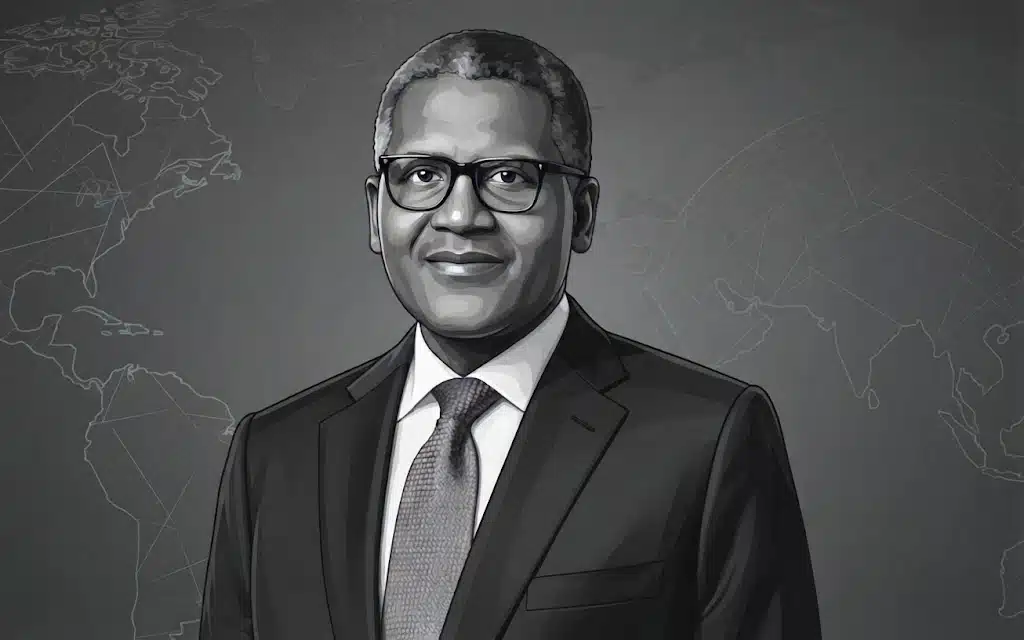


Forbes has just put Aliko Dangote’s wealth above $50 billion for the first time. The jump came after a private placement of shares in his oil refinery, an asset now valued at more than $46 billion, drew in over $3 billion of investor demand.
For a continent whose richest man has topped its billionaire list for fifteen straight years, the milestone raises an old question in a new form. Is there something in the Dangote model that other African entrepreneurs can actually copy, or is he simply a man who arrived at the right moment with the right connections?
Dangote’s closest rival is Abdulsamad Rabiu, another Kano-born industrialist whose BUA Group has, over the past decade, built a mirror image of the Dangote empire in sugar, cement and fertiliser. For nearly every product Dangote sells, Rabiu now sells one too. Observers have taken to describing BUA as the understudy that learned the whole script.
Yet even with that rivalry pushing him along, Rabiu remains roughly $40 billion behind Dangote, a gap wide enough that Dangote can fairly be called three times as rich as Rabiu himself.

What both men share, and what most Nigerian and African billionaires share more broadly, is a reliance on a narrow set of industries. Commodities, extraction and banking dominate the list. Oil, gas and mining built fortunes across the continent long before Dangote made his first bag of cement, and finance has quietly produced its own crop of tycoons in Lagos, Johannesburg and Cairo.
Dangote’s own trajectory fits this pattern more than his critics sometimes care to admit. He began as an importer of sugar and salt in the 1970s, following a family tradition; his great-grandfather traded groundnuts and other goods across the same northern region. However, a policy shift in the early 2000s, encouraged by the government of the day, turned Dangote from an importer of cement into a manufacturer of it. Dangote Cement became the base on which everything else was later built.
Forbes moved Dangote from 76th to 36th on its global billionaires list this year, a leap of forty places driven almost entirely by the refinery placement and an oversubscribed public listing expected to close in the coming days. Most people near the top of the global rich list made their money in technology, finance, fashion or real estate. Dangote made his in manufacturing, an industry that barely features among the world’s twenty richest people.
“What Amazon and Microsoft have done… but for an African company,” is how Dangote himself has described his ambition, a company built to create wealth broadly rather than concentrate it.
Whether that comparison holds is another matter. Amazon and Microsoft sell software and logistics to the whole world. Dangote sells cement, sugar and fuel largely to one country and a handful of its neighbours.
Is there a manufacturing goldmine in Africa?
Not everyone thinks so.
Bash Nijimbere, an economist based in Kenya, calls Dangote’s fortune an almost irreplaceable playbook, and he does not mince his reasoning. “Dangote is no doubt an astute businessman who knows the importance of being at the right place at the right time,” he told Businessfront. “His closeness and friendly position with the political establishment has also helped his industries grow as much as it is today.”
Dangote never attaches himself publicly to a political faction, which has let him remain useful to every administration rather than aligned with one. That neutrality, Nijimbere says, has been worth more to Dangote over the years than any single policy.
“He is known politically not to stir the pot, unlike most billionaires in Africa,” Nijimbere added.
On the other hand, Isaac Anache, a financial analyst who spoke with Businessfront, is more willing to see a pattern worth studying, though he is careful about how far it extends.
What can genuinely be learned from him, in Anache’s view, is his willingness to keep reinvesting and taking on new risk rather than sitting on what he has already built.
The right place, right time billionaire
The refinery itself illustrates both the opportunity and the difficulty of the Dangote model. Nigeria has for decades imported most of the petrol it consumes, despite being sub-Saharan Africa’s largest crude producer, a contradiction that has cost the country dearly in foreign exchange.
Dangote’s refinery, capable of processing 650,000 barrels a day and covering domestic petrol demand when running at full capacity, addresses that gap directly.
It was estimated last year that a fully operational refinery could lift Nigeria’s non-oil GDP by 1.5% and add $5.5 billion a year to official dollar reserves. Few private companies anywhere have that kind of macroeconomic weight resting on a single asset.
Building it required dredging a swamp on the edge of Lagos and constructing a port large enough to bring in equipment that no existing Nigerian infrastructure could handle. The scale of ambition is not something a typical entrepreneur can borrow their way into, no matter how sound their business plan.
“There’s a playbook here no doubt. But it’s not as neat and simple as some might want it to be,” Anache said. Dangote grew up in a family already steeped in trade, Anache notes, and he had access to capital at a stage in his career when most young entrepreneurs across the continent, especially now, would find borrowing prohibitively expensive.
“Most starting entrepreneurs in Africa may not be able to obtain such access to capital in such a high interest rate climate as of today. However, if there’s anything one can take from Dangote, it is his continued resilience and dedication to always reinvent and take sustained risks when it comes to investing on the continent,” Anache explains.
Meanhwile, Dangote himself has disputed the suggestion that the refinery relies tax breaks and import restrictions that built his cement business, though regulators’ reluctance to issue new petrol import licences echoes what happened with cement two decades ago closely enough that sceptics are entitled to their doubts.
Interest rates across much of Africa are punishing, and the kind of family capital and early political access that eased Dangote’s path are not available to most young entrepreneurs on the continent.
Dangote has said that his next phase of his ambition would be to help industrialise Africa. If Africans do not lead the continent’s industrialisation, he argues, nobody else will do it for them. The playbook that started in Nigeria has now extended to other parts of the continent.
For most African entrepreneurs, they see a blueprint in Dangote’s success, but it is difficult to know whether such an outlier can, in fact, be replicated.