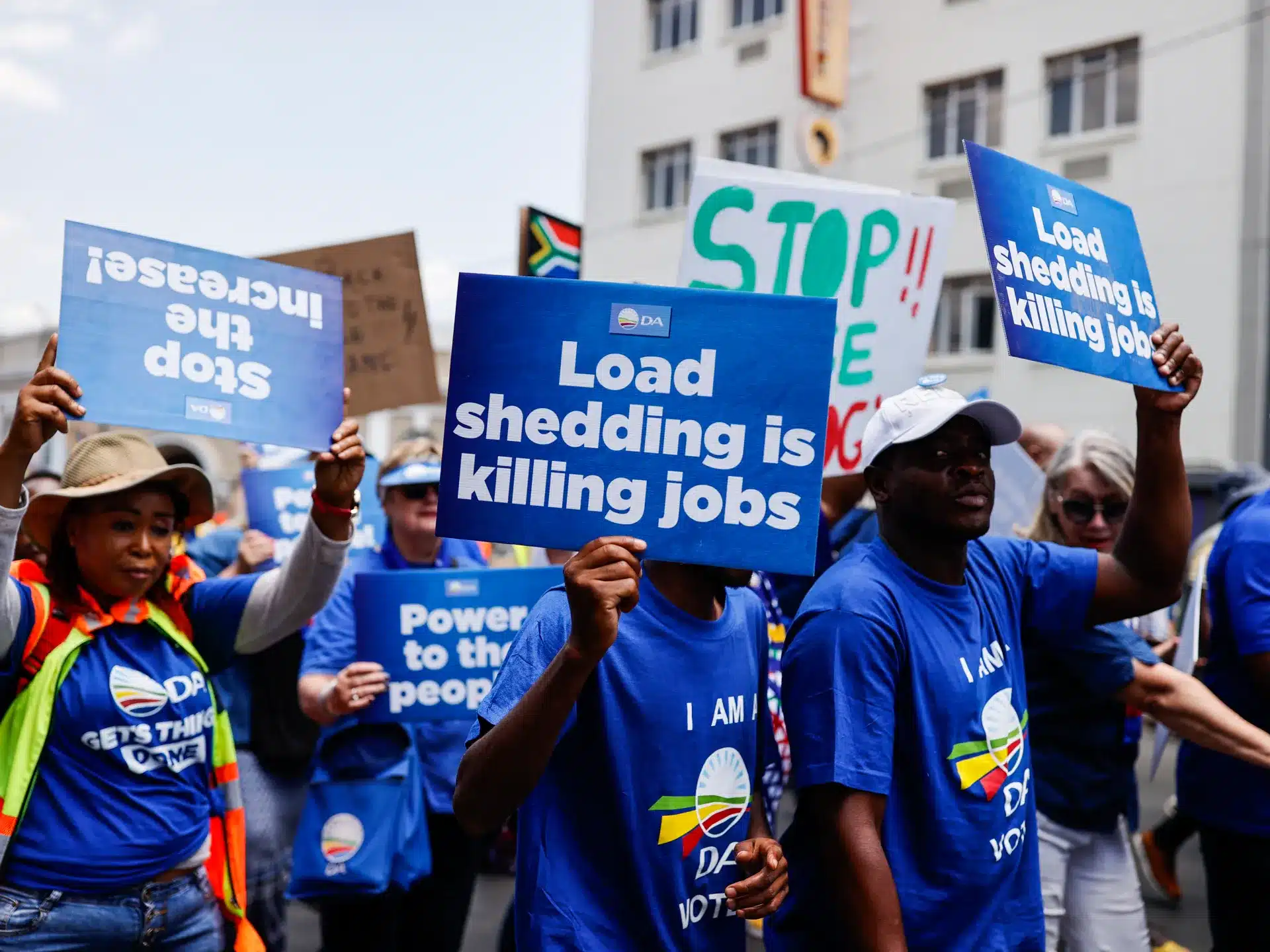


Ghana’s electricity workers were preparing to take their fight against private-sector participation in the Electricity Company of Ghana (ECG) to the streets on September 29.
The Public Utilities Workers Union (PUWU), alongside ECG’s senior and junior staff unions, had planned a nationwide protest against the government’s proposal. The protest however was suspended after the government reopened talks with the union and agreed to review its alternative proposals.
The dispute comes as the government prepares for the next stage of a reform that has been in the works since 2025. A transaction adviser appointed in May is expected to submit its initial report in the first week of October, setting out how private companies could become involved in running parts of electricity distribution.
The government insists it is not selling ECG. It has said private companies could initially take on areas such as billing, metering and collecting payments. But the final plan has not been decided. Earlier proposals considered wider arrangements, including concessions and leases for parts of the distribution network.
That uncertainty has made the argument harder to settle. ECG’s revenue has improved and its reported loss fell sharply in 2025. Yet Ghana’s wider electricity sector still needs heavy government support.
If ECG is improving under public management, why does Ghana still want private companies involved?
Why Ghana wants private companies in ECG
The government’s case starts with a problem that has persisted for years. Too much electricity is lost or goes unpaid before the money reaches the rest of the power sector.
A government technical committee identified governance, management and procurement weaknesses alongside high technical, commercial and collection losses. After examining eight possible models, it recommended three options. These include a single private operator, multiple private leases covering different areas, or a service franchise for lower-voltage distribution.
The government has since narrowed its public description of the plan. Energy Minister John Jinapor said in July 2025 that the immediate focus was on bringing private companies into billing and revenue collection rather than selling ECG.
The financial pressure, however, goes beyond billing.
Ghana’s energy-sector shortfall fell from about $1.6 billion in 2024 to $1.4 billion in 2025, according to the International Monetary Fund (IMF). The IMF estimates another $1.1 billion shortfall in 2026. It says high collection and distribution losses, costly generation contracts and accumulated debt remain major problems.
The government also paid about $1.47 billion towards energy-sector debts in 2025, including money owed to power producers and gas suppliers.
The IMF now sees private-sector involvement in electricity distribution as part of Ghana’s wider energy reforms. It says the government hired a transaction adviser to examine ECG and the Northern Electricity Distribution Company, with a plan for private participation expected by March 2027.
David Prosper, a policy analyst in Nigeria, told Businessfront that the debate should focus on whether the proposed arrangement can actually reduce the losses that have weakened ECG for years.
“What matters is not whether we call it privatisation or private-sector participation. The real issue is whether this arrangement can reduce the technical, commercial and collection losses that have weakened ECG for years.
“If the model does not address governance, procurement and revenue collection directly, it will not resolve the financial shortfall in the power sector,” Prosper said.
ECG is improving. So why change it?
This is where the workers have a strong argument.
ECG’s own financial accounts show that its position improved in 2025. Revenue rose from GH¢19.03 billion ($1.38 billion) in 2024 to GH¢22.11 billion ($1.61 billion) in 2025, while its after-tax loss fell from GH¢8.26 billion ($601 million) to GH¢2.52 billion ($184 million).
PUWU has used that improvement to challenge the need for a new private-sector arrangement.
Its general secretary, Timothy Nyame, argues that the gains show what stronger management and tighter controls can achieve.
System losses have also improved, although only slightly.
But those figures do not tell the whole story.

ECG’s 2025 reduction in its reported loss does not mean the company has become profitable. Its revenue remained below the cost of electricity purchases.
The wider energy sector continues to run a substantial deficit, while the IMF says some of the improvement in 2025 came from a stronger cedi, lower reliance on expensive liquid fuels and other macroeconomic conditions rather than a complete structural turnaround.
That leaves both sides with part of the argument. ECG has improved. But the underlying problem has not disappeared.
Workers say the problem is bigger than ECG
Moreover, PUWU’s objection is not simply that private companies should stay away from a state-owned utility.
The union argues that the government is focusing too much on the amount of money ECG collects while ignoring other problems. It has pointed to weak management, procurement, a shortage of meters, transformers and other infrastructure.
The union also says private companies already carry out several jobs for ECG, including billing software, meter installation and new connections.
Its position is that the government should improve how ECG is managed instead of bringing in more private operators.
Benjamin Koffi, an energy policy analyst, argued that ECG’s challenges cannot be reduced to collection losses alone.
“The focus has been on technical and commercial losses, but ECG’s problem is also about procurement and how money is spent within the company. If you bring in a private operator only for billing and revenue collection without fixing procurement, expenditure controls and infrastructure gaps like meters and transformers, the inefficiencies will remain. You may improve collections, but you will not fix why the losses were high in the first place,” Koffi told Businessfront.
This raises a simple question. If poor procurement, weak management and a lack of equipment are part of ECG’s problems, will a company brought in to collect bills be able to fix them?
There is also the customer side. Collecting more money may improve ECG’s finances, but customers still want working meters, accurate bills and reliable electricity.
The details of the new arrangement will therefore matter as much as the question of whether private companies are involved.
Ghana has tried private management before
The workers also have a recent example to point to.
In 2019, Ghana handed ECG’s operations, maintenance and management of part of its distribution network to Power Distribution Services Ghana Limited (PDS) under a 20-year concession backed by the Millennium Challenge Corporation’s (MCC) Ghana Power Compact.
The arrangement collapsed within months. The government terminated the concession in October 2019, and the MCC subsequently withdrew $190 million in funding associated with the concession.
The episode remains relevant because Ghana is now considering private participation in electricity distribution again.

The PDS experience provides an answer to the current debate and shows that a private concession can fail before its intended benefits are fully tested. It also reveals that private participation requires much more than choosing an operator.
The experience leaves Ghana with some difficult questions this time.
Who will carry the financial risk? What targets will private operators have to meet? How will they be paid? Who will regulate them? What happens if they fail? And what safeguards will prevent another breakdown like PDS?
Ghana has to answer those questions before the new arrangement takes shape.
The next fight is over what “private participation” actually means
For now, the final model remains unsettled.
The government says ECG will remain publicly owned. Its recent statements have focused on private involvement in billing and revenue collection, while the transaction adviser is examining the wider options.
PUWU’s planned protest has been suspended after the government agreed to reopen discussions and review the union’s alternative proposal. But the disagreement has not ended. The two sides are now negotiating while the transaction adviser prepares its recommendations.
Ghana now has to decide whether the remaining problems at ECG can be addressed by strengthening a utility that has already started to improve, or whether private operators should take over specific parts of its work.
The important issue is what either approach can change. Can ECG reduce the amount of electricity it loses? Can it collect more of the money it is owed? Can the power sector pay its suppliers on time? And can customers get better service?
The transaction adviser’s report will provide the next major test.
What the government does with its recommendations will show whether this latest push for private-sector involvement can fix some of ECG’s problems or whether Ghana is heading into another difficult attempt at reform.